

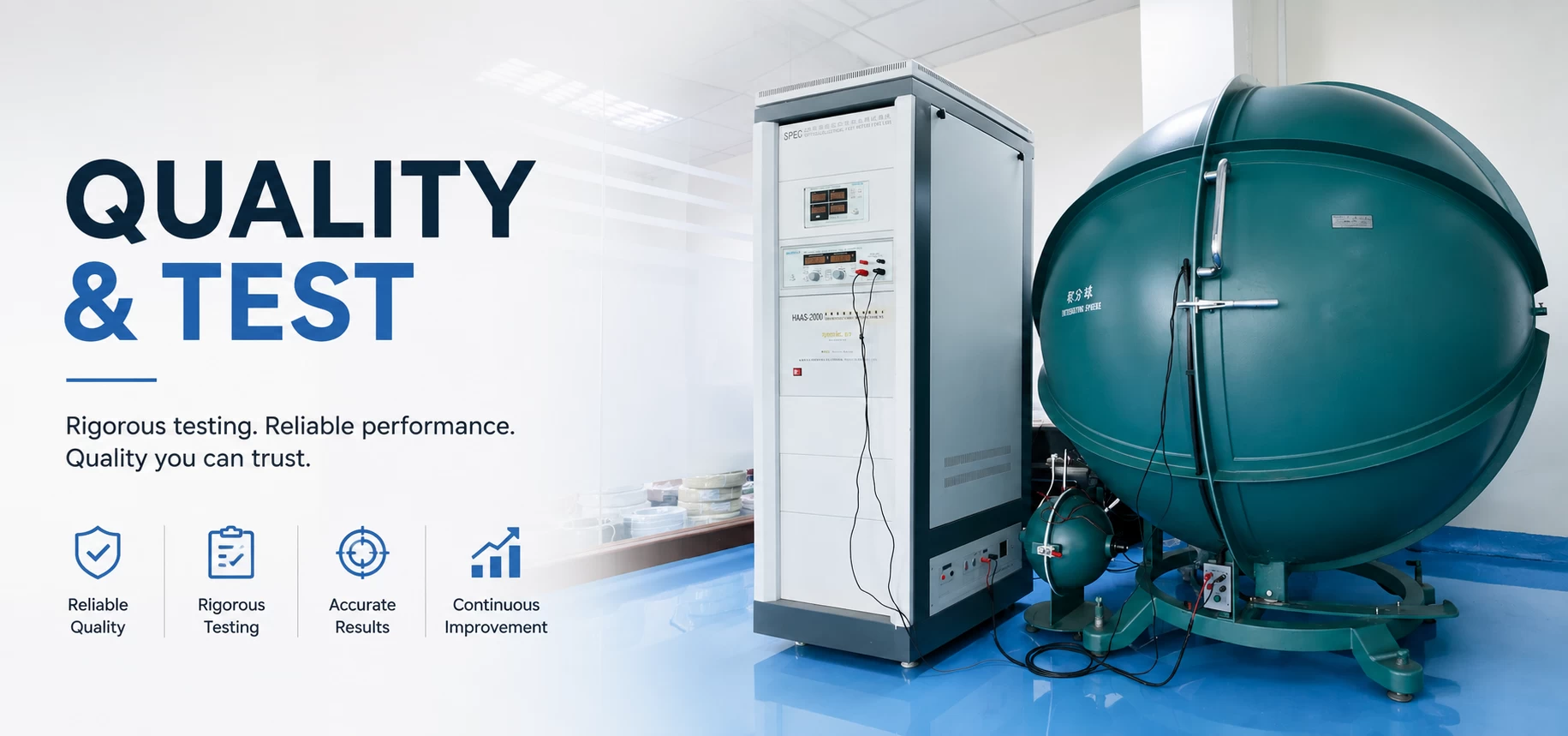
LED Module Quality Control & Testing
For custom OEM LED modules, quality control is not limited to checking whether the LEDs turn on.
The approved design, components, assembly quality, electrical and optical performance, and production consistency all need to be considered as a module moves from prototype into production.
At NKT, quality control and testing focus on the LED module itself. The exact checks depend on the module and project requirements, but the objective remains the same: to reproduce the approved design consistently and identify production issues before shipment.
Quality Control Starts With the Approved Design
Once a custom LED module has been approved for production, the confirmed design becomes the reference for manufacturing.
For customer-designed modules, NKT follows the approved drawings, BOM, component specifications, and other confirmed requirements.
For modules developed by NKT, the confirmed PCB design and component selection are also maintained during production.
Components are not changed simply because another part has the same package size or appears to have similar specifications.
This is especially important for LEDs. Two LEDs in the same package can still differ in forward voltage, light output, luminous efficacy, CCT, CRI, and other electrical or optical characteristics.
If an approved component becomes unavailable or reaches end of life, an alternative is reviewed and confirmed with the customer before it is introduced into production.
For projects involving certification requirements such as UL, DLC, or CE, component changes require particular care and are not made without confirmation.
100% Power-On Check After SMT Assembly
After SMT assembly, every LED module is powered on.
We check that all LEDs illuminate correctly and look for issues such as a single LED that does not light, a complete LED string that remains dark, incorrect or missing components, connector problems, or visible soldering issues.
A dark LED does not automatically mean that the LED itself has failed.
Depending on the circuit, the cause may be the LED, a solder joint, an open circuit, another component, a damaged PCB connection, or a connector issue.
When a problem is found, the module is checked and the cause is investigated before it continues through production.
This 100% power-on check provides a functional checkpoint immediately after assembly rather than waiting until final inspection to identify a problem.
Electrical Checks on the Assembled Module
A module that lights correctly still needs to operate within its expected electrical parameters.
NKT checks the assembled module's voltage and current against the expected operating parameters for the project.
For a constant-current LED module, the measured board voltage is related to the forward voltage of the LEDs , the number of LEDs in each series string, and the overall series-parallel circuit configuration.
When a module operates with a constant-current driver, its operating voltage also needs to remain within the driver's output-voltage range.
These electrical checks provide useful information about the assembled board and can help identify a circuit or assembly issue that may not be obvious from the power-on inspection alone.
Connectors and solder joints are also visually checked as part of the production inspection.
Optical Testing Depends on the LED Module
Different types of LED modules require different optical measurements.
White LED Modules
During sample or first-board validation, white-light modules are typically measured for:
- luminous flux
- luminous efficacy
- CCT
- CRI
- voltage
- current
During development, initial performance estimates are normally based on LED manufacturer datasheets.
Once a physical module has been assembled, actual measurements allow those estimates to be checked against the real board. If necessary, the results can then be used to adjust the module before the design is confirmed for production.
During production, optical performance is checked by sampling rather than measuring every production module in the integrating sphere.
Colored LED Modules
For colored LED modules, wavelength and brightness are more relevant parameters than CCT and CRI.
The measurements therefore focus on the characteristics that matter for the particular color LED and application.
UV LED Modules
For UV LED modules, NKT measures optical power rather than visible-light lumen output.
A UV module and a white-light module serve different functions, so applying the same optical measurements to both would not provide useful information.
The optical test is therefore selected according to the type and intended function of the LED module.
Selected Modules Undergo an 8-Hour Burn-In Test
A short power-on check confirms that a module is operating at that moment.
Selected production modules are also operated continuously for eight hours as a burn-in test.
The longer operating period provides an additional opportunity to identify abnormal behavior or an early failure before shipment.
If a problem appears during burn-in, the module can be investigated rather than relying only on the earlier short-duration power-on check.
The 8-hour burn-in test is a production screening step. It is not intended as a lifetime test or as a prediction of how long the LED module will operate inside the customer's finished product.
Long-term performance also depends on operating current, thermal conditions, installation, and the actual application environment.
Component Control Helps Maintain Production Consistency
Not every quality issue can be found through electrical or optical testing.
For an OEM module that may remain in production for years, maintaining the approved component configuration is also part of quality control.
NKT does not substitute customer-specified components without approval. For modules developed by NKT, confirmed components are likewise maintained once the design has been approved.
If an LED or another critical component becomes unavailable or reaches end of life, the proposed alternative is reviewed with the customer before a production change is made.
Where necessary, a new sample can be produced for confirmation before the replacement is introduced into production.
This helps prevent an apparently small component change from creating an unintended change in the electrical or optical performance of the module.
Final Power-On Check Before Packing
The power-on check after SMT assembly is not the final functional check.
Before packing, LED modules are powered on again.
This provides another opportunity to confirm correct operation after the modules have passed through the production and handling process.
The general assembly condition, connectors, and applicable project requirements are also checked before shipment.
For a typical custom LED module, the production quality process can therefore include:
Approved Design & Components → SMT Assembly → 100% Power-On Check → Electrical Checks → Optical Sampling Where Applicable → Selected 8-Hour Burn-In → Final Power-On & Inspection → Packing
The exact checks can vary according to the module and customer requirements, but the objective is consistent: reproduce the approved module and identify production issues before shipment.
Module Testing and Final Product Validation Are Different
NKT's testing focuses on the LED module itself.
Final thermal performance depends on how that module operates inside the customer's finished product, including the housing, heatsink, installation method, airflow, ambient conditions, and actual operating environment.
For this reason, final thermal validation is performed by the customer under conditions representative of the finished product.
This keeps module-level testing and final product validation clearly separated.
From Prototype to Repeatable Production
A working prototype is important, but repeatable production requires more than producing one successful sample.
The approved components and design need to remain consistent. Assembly issues need to be identified. Electrical and relevant optical parameters need to be checked. Selected modules can be screened through burn-in testing, and operation is checked again before shipment.
For a new project, prototype validation before production helps establish the module that will become the reference for production.
You can also review NKT's LED module engineering capabilities to see how NKT supports LED module development from PCB design and component selection through prototype validation and production support.
If you already have a PCB drawing, BOM, module dimensions, target light output, or electrical requirements, send us your LED module requirements.