

An OEM product may remain in production for many years. The LED components inside it may not.
In 2025, NKT received an EOL notice through our Samsung LED supply channel for a 4014 LED used in an existing product for an Italian OEM customer.
There were still approximately six months before the planned discontinuation.
We did not wait until the LED became unavailable.
We informed the customer, suggested keeping additional stock of the existing LED as a temporary buffer, and started evaluating replacement options at the same time.
The objective was simple: have an approved replacement ready before the original LED was no longer available.
The replacement has since been sampled, confirmed and moved into production.
For an OEM product already in repeat production, this is what component EOL is really about. Finding another LED is only part of the job. The larger issue is how to make the change without creating an unnecessary interruption in production.
An EOL Notice Gives You Time to Prepare
An EOL notice does not necessarily mean that the component becomes unavailable immediately.
When advance notice is available, it creates an opportunity to deal with two problems separately.
The first is short-term supply.
In this project, the customer could keep some additional inventory of the existing Samsung LED as a buffer.
The second is future production.
While the existing component was still available, NKT could review alternative LEDs, compare their specifications and prepare samples using the proposed replacement.
This is much safer than beginning the replacement process only after the original component can no longer be purchased.
However, advance notice is not always available to us.
For LED categories purchased regularly, lifecycle information may reach NKT through the manufacturer or supply channel. For components purchased less frequently, we may only discover an availability or EOL issue when the material is needed for another production order.
That is why component availability remains relevant even after an LED module has already been designed and approved.
Finding Another 4014 LED Was Only the Beginning
The original LED in this project belonged to Samsung's LM401BA+ 4014 family. The Samsung datasheet identifies it as a 4014 mid-power LED family and includes the electrical, optical and binning information needed to define the component more precisely.
The LED was used on a long linear module containing 110 pieces of 4014 LEDs.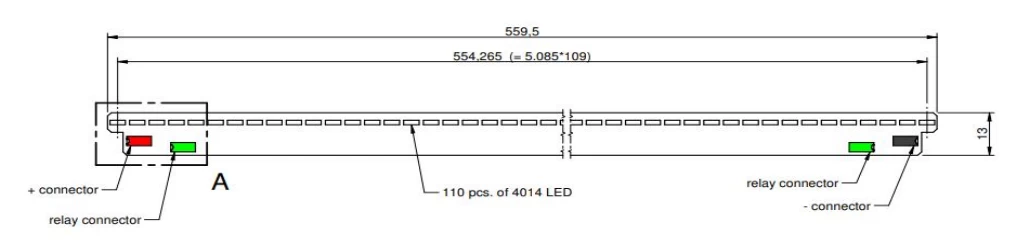
Engineering drawing of the existing OEM LED module using 110 pcs. of 4014 LEDs. When the original LED approached EOL, NKT needed to evaluate a replacement for future production.
The drawing helps illustrate why this was not simply a purchasing question.
A replacement LED had to work within an existing module that had already been designed and produced.
Finding another LED with a similar package was therefore only the first screening step.
For an LED replacement, we may need to compare:
- package dimensions and PCB footprint;
- forward voltage;
- operating current;
- luminous output and efficacy;
- CCT and CRI for white LEDs;
- wavelength for colored or UV LEDs;
- optical characteristics relevant to the application.
The replacement eventually selected for this project was an Everlight 50-217ST family LED.
Its datasheet, for example, specifies a 60 mA operating point and defines forward-voltage, luminous-flux, CCT and CRI options. The mass-production list also shows that available luminous-flux ranges differ according to the exact CCT version.
This is why saying that two LEDs are both “4014 LEDs” is not enough to establish that one can replace the other.
For a broader discussion of the parameters involved in LED selection, see how to select LEDs for a custom LED module.
A Technically Possible Replacement Is Not Always the Final Choice
During this project, NKT considered more than one possible replacement.
One candidate was a Bridgelux LED.
Although it was considered technically, we had concerns about its long-term supply continuity for this particular project. Rather than risk dealing with another component change later, we continued evaluating other options.
We eventually selected an Everlight LED.
This introduces another consideration that is especially important for OEM products:
A replacement component needs to make sense not only for the next production order, but also for continued production.
Electrical and optical specifications matter, but component availability matters too.
This does not mean that anyone can guarantee how long a particular LED will remain available. We cannot.
It means that when several technically suitable choices exist, supply continuity can be one of the factors considered before investing in a replacement.
That was part of the decision in this project.
Datasheet Comparison Was Not the End of the Replacement Process
After selecting the Everlight candidate, NKT did not simply update the BOM and continue production.
We made new samples using the replacement LED and checked the module before the change was confirmed.
The Everlight version has since moved into production.
This distinction matters because a datasheet comparison can identify a promising replacement, but it cannot by itself confirm how the changed module will perform in the customer's actual product.
The amount of validation required can also depend on the nature of the change.
If the original manufacturer offers a closely related replacement with only limited differences, there are situations where datasheet review and customer confirmation may be sufficient.
When changing to an LED from another manufacturer, NKT normally takes a more cautious approach and prepares a new sample for confirmation before introducing the change into repeat production.
This follows the same principle we use during normal prototype development: the approved production configuration should be based on what has actually been reviewed and confirmed, not only on what appears suitable on paper.
For more on this stage, see what to check before an LED module enters mass production.
Not Every Component Change Needs the Same Level of Review
LEDs are not the only components that can become unavailable.
NKT has also encountered discontinued resistors.
For a standard resistor, replacement is usually much more straightforward if the required resistance, tolerance and package remain the same and there are no other project-specific restrictions.
We have also had to replace an optical lens.
In that case, changes in the market meant that the original lens was no longer commercially attractive for the supplier to continue producing, so another lens had to be considered.
The replacement question was different from an LED change.
There was no LED forward voltage, current or CCT to compare, but the new lens still needed to fit mechanically and provide suitable optical performance.
These experiences are why we do not think of component EOL as one fixed substitution procedure.
The amount of evaluation should depend on what the component does in the module and what could change when it is replaced.
An Approved Production BOM Should Not Change Silently
Once an OEM LED module has been approved and entered repeat production, NKT does not change a critical component simply because another part becomes easier to purchase.
If an approved LED becomes unavailable or reaches EOL, we discuss the proposed change with the customer.
This is particularly important when the customer originally specified the LED or other component.
Even when NKT developed the module, the BOM used for an approved production configuration represents something the customer has already evaluated.
For the Samsung 4014 project, the process was therefore not:
Original LED approaching EOL → buy another 4014 LED → continue production.
It was:
EOL notice → inform customer → prepare inventory buffer → evaluate replacement options → select candidate → build samples → verify the changed module → customer confirmation → move the replacement into production.
That difference is important.
The objective is not to prevent components from ever changing. In a long-running OEM product, that may not be realistic.
The objective is to make necessary changes in a controlled way.
Component EOL Is Ultimately a Production-Continuity Issue
No LED module manufacturer can guarantee that every LED, resistor, connector, lens or other component will remain available throughout the complete life of an OEM product.
The more useful question is:
What happens when one of those components changes?
In this project, approximately six months of advance notice gave both NKT and the customer time to prepare.
The customer could maintain a temporary inventory buffer.
NKT could evaluate alternatives while the original LED was still available.
The replacement could be sampled and confirmed before it was needed for future production.
And when the change became necessary, there was already a replacement path.
For an OEM product expected to remain in production for years, this type of component support is part of maintaining the LED module—not a separate issue that begins only when purchasing fails.
You can learn more about NKT custom OEM LED module development and production support.
If an LED or another important component in an existing OEM module is approaching EOL, NKT can review the existing design and component requirements and help evaluate a replacement path before the original part becomes unavailable.
Discuss your existing OEM LED module or component replacement project.