

An OEM LED module may stay in production for years.
A customer may reorder it every few months, or a product may return after a much longer gap. During that time, LED manufacturers may update components, performance may improve, and materials that were originally approved may change in availability.
So how can an OEM keep the LED module consistent across repeat production?
What Maintains Consistency Across Repeat LED Module Orders?
Repeat-production consistency starts with a controlled reference: the approved PCB design, BOM, LED part number, customer drawings, test records and physical samples. Future orders should follow that reference unless a component becomes unavailable or a proposed change creates enough value to justify customer review and revalidation.
At NKT, this means the approved design remains the production baseline. But it does not mean that every component must remain frozen forever.
An approved LED module should not change silently. The existing design remains the production reference until there is a justified reason for a change and the customer approves it.
That distinction becomes increasingly important as an OEM product stays in production for years.
What Becomes the Reference for Future Production?
Once a custom LED module has been sampled and approved, future production should not depend on someone's memory of the original project.
NKT retains the information needed to reproduce the approved module, including:
- Gerber files and PCB drawings
- BOM
- Customer drawings
- Exact LED part numbers
- Relevant electrical and optical test records
- Physical reference samples
For white LED modules produced in multiple color temperatures, NKT retains a separate sample for each confirmed CCT version.
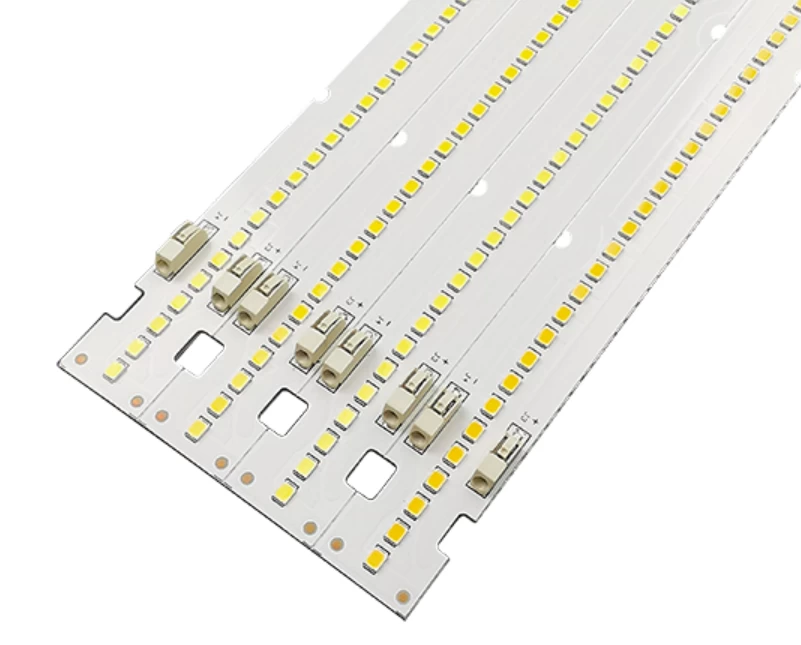
Four CCT versions of the same OEM LED module design. NKT retains a reference sample for each confirmed color temperature to support future repeat production.
For modules produced regularly, the confirmed production documents, BOM and established test references normally provide the working baseline.
When an older product returns after a long period without production, the retained sample can also be brought out and reviewed together with those records.
The physical sample does not replace the drawings or specifications. It provides another reference to the product the customer previously approved.
Consistency Does Not Mean Reproducing One Exact Test Number
There is an important distinction between product consistency and reproducing one historical measurement exactly.
White LED parameters such as luminous flux, CCT and CRI are normally specified and accepted within defined ranges.
Previous test records therefore provide a comparison point, but a later production run is not expected to reproduce every original measurement digit for digit.
The objective is to confirm that the module still meets the approved product requirements and remains consistent with the established production reference.
This is more useful than treating one measurement from one sample as a permanent target for every future production batch.
The Approved BOM Is the Starting Point
When a repeat order arrives, NKT normally purchases materials according to the approved BOM.
A newer LED does not automatically replace the existing one.
Changing a component in an established OEM product can create work beyond the component itself. Depending on the project, a change may require new samples, electrical or optical verification, customer testing, documentation updates, or review of certification requirements.
If the existing LED remains available and still meets the approved requirements, there may be little reason to introduce that work.
This is especially relevant for low-volume products. A newer LED may look better on a datasheet, but the actual benefit may be small compared with the time and cost required to validate the change.
If an approved component becomes unavailable rather than simply being superseded by a newer option, the decision is different. We explain that process separately in LED Component EOL and Replacement in an Existing OEM Module.
A Real Example: STW8A2PD to Later LED Revisions
LED manufacturers continue developing their product families while OEM products remain in production.
NKT has experienced this with Seoul Semiconductor's STW8A2PD family.
One existing product originally used the STW8A2PD. Later versions in the same product family included STW8A2PD-H2 and STW8A2PD-H4.
The important point is not simply that the suffix changed. The available LED performance changed as the product family developed.
The corresponding Seoul Semiconductor datasheets provide a useful comparison:
| LED Version | Datasheet Date | Package Size | Test Current | 4000K Luminous Flux | CRI |
|---|---|---|---|---|---|
| STW8A2PD | Sep. 2016 | 3.5 × 2.8 × 0.7 mm | 65 mA | Up to 33.6 lm* | Min. 80 |
| STW8A2PD-H2 | Dec. 2022 | 3.5 × 2.8 × 0.7 mm | 65 mA | 36–38 lm | Min. 80 |
| STW8A2PD-H4 | Jan. 2024 | 3.5 × 2.8 × 0.7 mm | 65 mA | 38–40 lm | Min. 80 |
*The original STW8A2PD datasheet lists multiple luminous-flux ranks at 4000K. 33.6 lm is the upper end of the highest listed rank, not a single nominal output value.
In this example, the LED family retained the same 3.5 × 2.8 × 0.7 mm package format and a comparable 65 mA test condition, while the specified 4000K luminous-flux range increased in later versions. That makes the newer LED worth evaluating, but does not by itself make it an approved substitute.
That last distinction matters.
A datasheet can show that a newer LED offers better specified output. It cannot decide whether changing an already-approved OEM product is worthwhile.
Should an Existing OEM Product Change to the Newer LED?
There is no single answer for every project.
A practical decision looks more like this:
| Production Situation | Practical Approach |
|---|---|
| Approved LED is available and still meets requirements | Continue with the approved BOM |
| Newer LED offers limited benefit for a low-volume product | The change may not justify revalidation |
| Newer LED offers meaningful benefit for repeat-volume production | Evaluate the update and present it to the customer |
| Approved LED becomes unavailable or reaches EOL | Evaluate a replacement and obtain customer approval |
| A change may affect certification requirements | Review the project-specific certification implications before approval |
For a low-volume product, continuing with the existing LED may therefore be the better decision.
If the original component remains available and the module continues to meet its requirements, a modest improvement in LED output may not justify another sample, customer testing or other approval work.
For a product with meaningful repeat volume, however, the calculation can change.
If an updated LED provides a useful performance improvement without increasing component cost, that improvement can become more meaningful over repeated production. In that situation, NKT may present the updated LED to the customer as an option.
The customer then decides whether the benefit justifies the validation work required for the particular project.
A technically better component is not automatically a better production decision. The benefit has to be considered together with production volume, validation effort and the requirements of the customer's product.
What Happens If the Customer Approves the Change?
Customer approval is not simply permission to change the part number on the BOM.
Depending on the change and the project, the updated module may need to return to sample validation before the revised version becomes the new production reference.
The relevant electrical and optical parameters can then be checked against the project requirements, and the customer can perform any product-level validation required in the final application.
For more detail on this stage, see LED Module Prototype Validation Before Mass Production.
For products with certification requirements, the implications of a component change must also be considered according to the specific product and approval requirements. A component revision should not be assumed to have the same certification impact in every project.
Once the revised version is confirmed, the updated documents and approved sample become the reference for subsequent production.
Why Physical Reference Samples Still Matter
Gerber files define the PCB.
The BOM identifies the approved components.
Drawings record dimensions and other project requirements.
Test records document the confirmed electrical and optical results.
So why retain the physical module as well?
Because when an OEM product returns after a long production gap, the sample provides a direct physical reference to the version that was previously approved.
This is particularly useful for product families with several versions.
For example, if the same white LED module was produced in four different CCTs, retaining one confirmed sample of each version avoids relying on a single board to represent the entire product family.
The sample is therefore not a replacement for controlled documentation.
It complements it.
Repeat-Production Consistency Is Really About Controlled Change
For a long-running OEM LED module, consistency is not simply the ability to manufacture the same PCB again.
It requires a stable reference for what was approved and a controlled process for deciding when that reference should change.
The approved BOM, drawings, test records and reference samples establish the baseline.
If the original components remain suitable and available, continuing with them may be the best decision.
If an updated component creates meaningful value, it can be evaluated and proposed to the customer.
If a component becomes unavailable, replacement becomes a different engineering and supply-continuity problem.
In all three situations, the principle is the same:
The change should be deliberate, validated where necessary, documented and communicated — not introduced silently into repeat production.
For OEM manufacturers developing a new LED module or managing continued production of an existing design, NKT provides development, prototype validation and production support through NKT Custom OEM LED Module Solutions.
Technical References
Seoul Semiconductor, STW8A2PD, Mid-Power LED Datasheet, Rev. 1.1, September 7, 2016.
Seoul Semiconductor, STW8A2PD-H2, Mid-Power LED Datasheet, Rev. 1.0, December 16, 2022.
Seoul Semiconductor, STW8A2PD-H4, Mid-Power LED Datasheet, Rev. 1.3, January 9, 2024.
The manufacturer datasheets above were used to verify the LED package, test conditions and luminous-flux values in the comparison. NKT's production practices and project decisions described in this article are based on NKT's own OEM experience.
Need Support for Your OEM LED Module Project?
Whether you are developing a new custom LED module or managing repeat production for an existing design, NKT can support module development, prototype validation and continued production based on your confirmed project requirements.
Request a Quote