

An OEM customer approves an LED module sample. The module can move into production.
So what exactly has been approved—and what can still change later?
In NKT's projects, overseas customers normally confirm sample approval by email. Once that happens, the confirmed PCB design, LED layout, BOM, LED part number, connector, drawings and related production information become the reference for production.
But “frozen” does not mean the module can never change again.
It means that the approved design should no longer change without a reason, customer communication and an appropriate level of confirmation.
That distinction becomes important later, because not every post-approval change has the same impact.
An Approved Module Can Still Change After Production Begins
One of NKT's customers had already approved an LED module and placed several production orders.
The module itself was no longer a new development.
After using it in its actual assembly process, however, the customer found that the terminal position was inconvenient for wiring. They asked NKT to move the terminal.
This is a useful example of what prototype approval actually means.
The customer had approved the design based on the information and validation available at that stage. Later production experience revealed an integration detail they wanted to improve.
NKT changed the terminal position according to the customer's request and updated the drawing.
But the customer did not necessarily need another physical sample simply because the approved design had changed.
For this type of revision, a customer may decide that reviewing and approving the revised drawing is sufficient. Once the new drawing is approved, that revision can become the production reference for subsequent orders.
This does not mean terminal-position changes never require samples. It means the confirmation method depends on what changed and what the customer needs to verify.
A PCB Material Change Was Different
Another NKT project involved a more substantial revision.
The module had originally been developed with an aluminum PCB. The customer later asked NKT to investigate a lighter CEM-3 PCB with thermal capability similar to PCB constructions they had seen in products from major lighting manufacturers.
This change could not be handled simply by updating a component position on a drawing.
Suitable thermally capable CEM-3 material was difficult to source from the available supply base. NKT spent considerable time searching for an appropriate option and eventually identified a suitable Panasonic CEM-3 material.
A new PCB and module sample were then produced for the customer to evaluate and approve before the revised construction was adopted.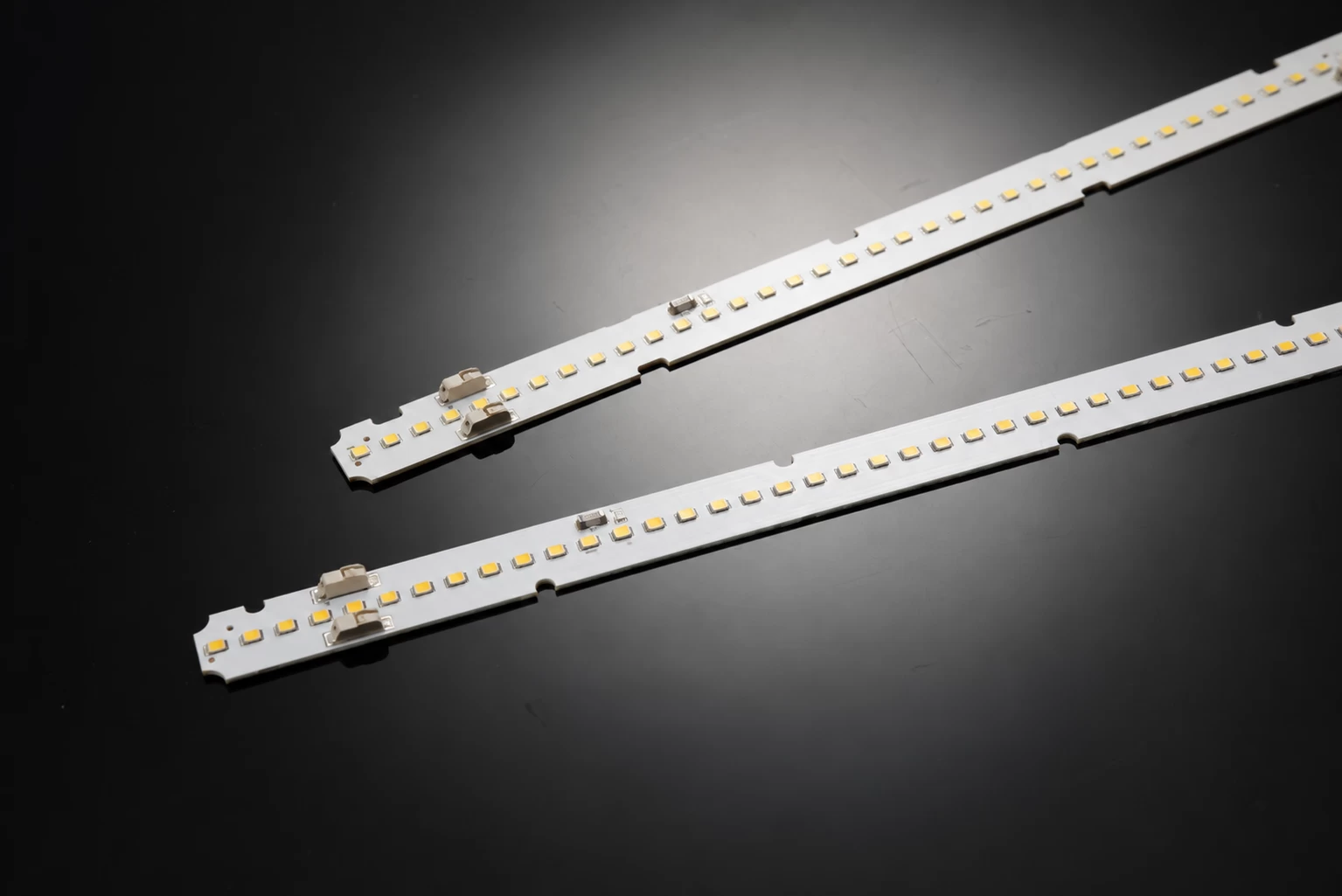
The point of this example is not that CEM-3 is better than aluminum PCB. That conclusion would not be supported by one project.
The important difference is that the customer was changing the PCB construction itself. In this case, NKT and the customer treated the revision differently from a terminal-location change and used a new physical sample for confirmation.
After prototype approval, different changes can require different levels of revalidation. The purpose of a design freeze is to control change—not to force every change through an identical approval process.
What Is Actually Frozen After Prototype Approval?
The two projects above make the answer clearer.
Once an NKT-developed LED module is approved, the confirmed design becomes the production reference. Depending on the project, that reference normally includes the PCB/Gerber, LED layout, BOM, exact LED part number, connector and position, confirmed drawings and the approved physical sample.
The electrical and optical performance is tied to that approved configuration as well.
NKT does not normally create a separate “freeze” for every voltage, current, lumen, CCT or CRI value. Once the LED, circuit, operating conditions and approved specifications are established, those parameters are already part of the confirmed module configuration.
For optical parameters such as luminous flux, CCT and CRI, production also has to be understood against the applicable confirmed specification or range—not as an expectation that every module will reproduce one identical numerical reading.
The situation is slightly different when NKT is manufacturing from a customer-controlled design. If the customer provides the drawing, BOM or other defined production documents, those documents remain the governing reference. NKT does not independently change customer-specified parts or design details.
Why NKT Usually Does Not “Optimize” an Approved Module on Its Own
A module manufacturer sees the LED PCB. The OEM customer sees the complete product.
Those are not always the same engineering perspective.
NKT may notice something on an approved module that could theoretically be arranged differently. But we normally do not change an approved design simply because the alternative appears better from the module side.
We may not know every condition in the customer's final assembly: how the module is installed, how wiring is routed, what other components are nearby, how the optics interact with the module, or which product-level requirements influenced the original decision.
A change that looks like an improvement in isolation may therefore be undesirable in the final application.
That is why most post-approval changes begin with a specific reason and customer communication. In the terminal example, the customer had discovered an assembly issue. In the CEM-3 example, the customer specifically wanted a different PCB construction.
If NKT encounters another reason that may require a change—such as component availability—the issue is raised with the customer rather than silently incorporated into production.
That situation is covered separately in our article on LED component EOL and replacement in an existing OEM module.
A Change Creates a New Reference, Not an Informal Exception
The most important part of a post-approval change is what happens after the customer accepts it.
The revised design should not remain an informal instruction such as “move this connector on the next order.”
The applicable drawing, PCB information, BOM or other affected project documentation needs to reflect the approved revision. If a new sample was required, that confirmed version can also become part of the new reference for future production.
In practical terms, the sequence is:
Approved design → requested or necessary change → appropriate review or validation → customer approval → revised production reference
The level of validation in the middle can vary.
The requirement for a controlled reference at the end should not.
This is also why design freeze and long-term production consistency are related but different questions. Design freeze establishes what has been approved. Repeat-production control is about how that approved reference is maintained across later orders.
For that next question, see maintaining LED module consistency across repeat OEM production.
Design Freeze Establishes the Baseline for Future Changes
Prototype approval is not the point where an OEM LED module becomes permanently untouchable.
It is the point where the project gains a defined production reference.
A terminal can still move. A PCB construction can still change. An LED may eventually need to be replaced. A customer may revise a requirement.
But those changes should be visible decisions rather than gradual, undocumented changes to an approved product.
The practical principle is straightforward:
The approved version establishes the baseline. Future changes are evaluated against that baseline, confirmed at a level appropriate to the change, and incorporated only after the revised version is accepted.
For OEM manufacturers developing a module around specific product dimensions, electrical requirements and target performance, NKT provides custom OEM LED module development from early module development through prototype validation and production support.
Need Support With an OEM LED Module Project?
Whether you are developing a new custom LED module or moving an approved design into production, NKT can support PCB layout, component selection, prototype validation and continued module production based on your confirmed project requirements.