

In many OEM lighting projects, the customer already has a controller. What they need is an LED module that works with it.
This sounds straightforward until the module contains multiple LED channels.
An RGBW module may need four separately controlled color channels. A tunable white module uses two white LED groups with different color temperatures. A dual-wavelength UV module may require two LED groups that operate at different times and have different electrical characteristics.
The controller handles channel operation, but it does not determine how the LEDs should be arranged on the PCB or how their circuits should be configured.
Those decisions belong to the LED module design.
At NKT, we have developed custom multi-channel LED modules for these applications. The projects differ, but they illustrate a common principle: the electrical interface between the customer's controller and the LED module needs to be understood before the module design is finalized.
What Does Multi-Channel LED Module Design Involve?
A multi-channel LED module contains two or more LED groups intended to be controlled separately by an external system.
Designing one begins with the customer's requirements: what each channel must produce, how it will be powered and controlled, and how the module must fit into the finished product.
The module designer then evaluates the LED selection, circuit configuration, PCB arrangement and connection interface.
The design process can be summarized as:
Customer's channel requirements and controller outputs → LED selection and channel configuration → PCB layout and connections → prototype evaluation → customer system validation.
This does not mean every project follows exactly the same sequence. For example, a customer may already have specified the LEDs, or the housing dimensions may be fixed before the electrical design begins.
The important point is that the LED module cannot be developed independently of the electrical and mechanical conditions of the product in which it will operate.
An RGBW Project Using Nichia RGB and Seoul White LEDs
One earlier project for a US customer involved a custom RGBW LED module.
The design combined a Nichia RGB LED with a separate Seoul Semiconductor white LED. NKT recommended the Nichia RGB LED, while Seoul Semiconductor was a brand we commonly used for white LED modules at that time.
The RGB package provided the red, green and blue channels. The separate white LED provided the white channel.
The module used two 2-pin terminals and one 1-pin terminal, providing five terminal positions for the four color channels and a shared common connection.
The customer's own controller handled the color control.
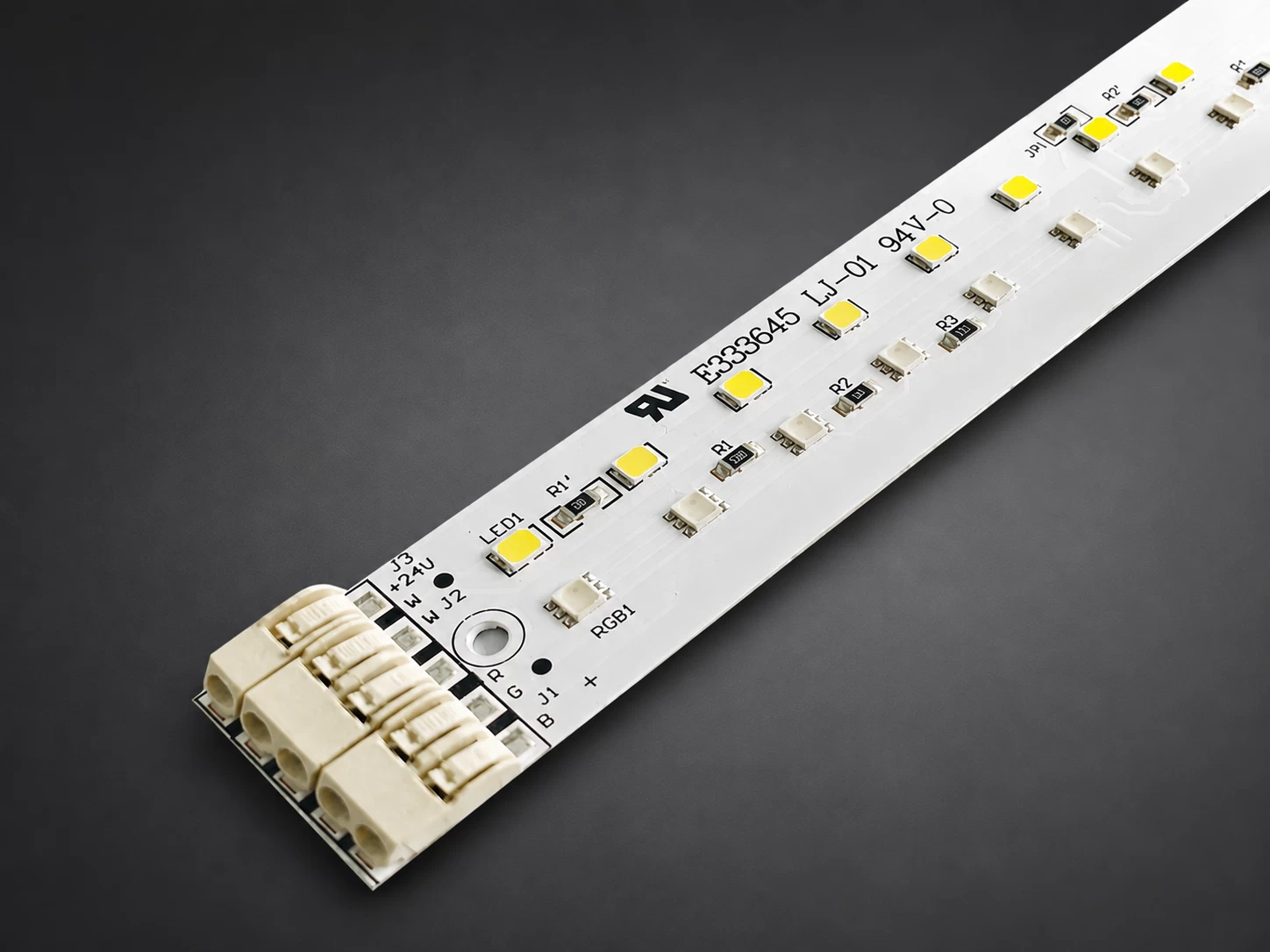
What makes this project useful as an engineering example is not simply the use of two LED brands.
It shows that the number of LED packages, the number of controllable channels and the number of electrical connections are different design considerations.
In this case, the RGB function came from a single multicolor LED package, while white light came from a separate LED. The module still needed to provide the required electrical connections to the customer's controller.
Another RGBW project could use a different combination of LED packages or a different connector arrangement. Neither the LED package selection nor the physical connector configuration should be assumed from the term RGBW alone.
For an OEM customer, the useful starting information is therefore not just “we need RGBW.” It is also the controller's channel outputs, the intended electrical connection arrangement and any restrictions on connector position.
Tunable White: Two CCT Groups Instead of Four Color Channels
NKT has also developed tunable white modules using two groups of white LEDs: 2700K and 6500K.
In this application, the customer's controller adjusts the relative output of the two groups to change the resulting white-light color temperature.
The module architecture is different from RGBW.
RGBW provides red, green, blue and white channels for color control. A two-channel tunable white module instead uses two white LED groups with different nominal color temperatures.
That difference affects what the PCB must accommodate.
The two groups need appropriate circuit configurations and electrical connections. Their physical arrangement also matters because the customer will see the combined light, not two separate groups of LEDs.
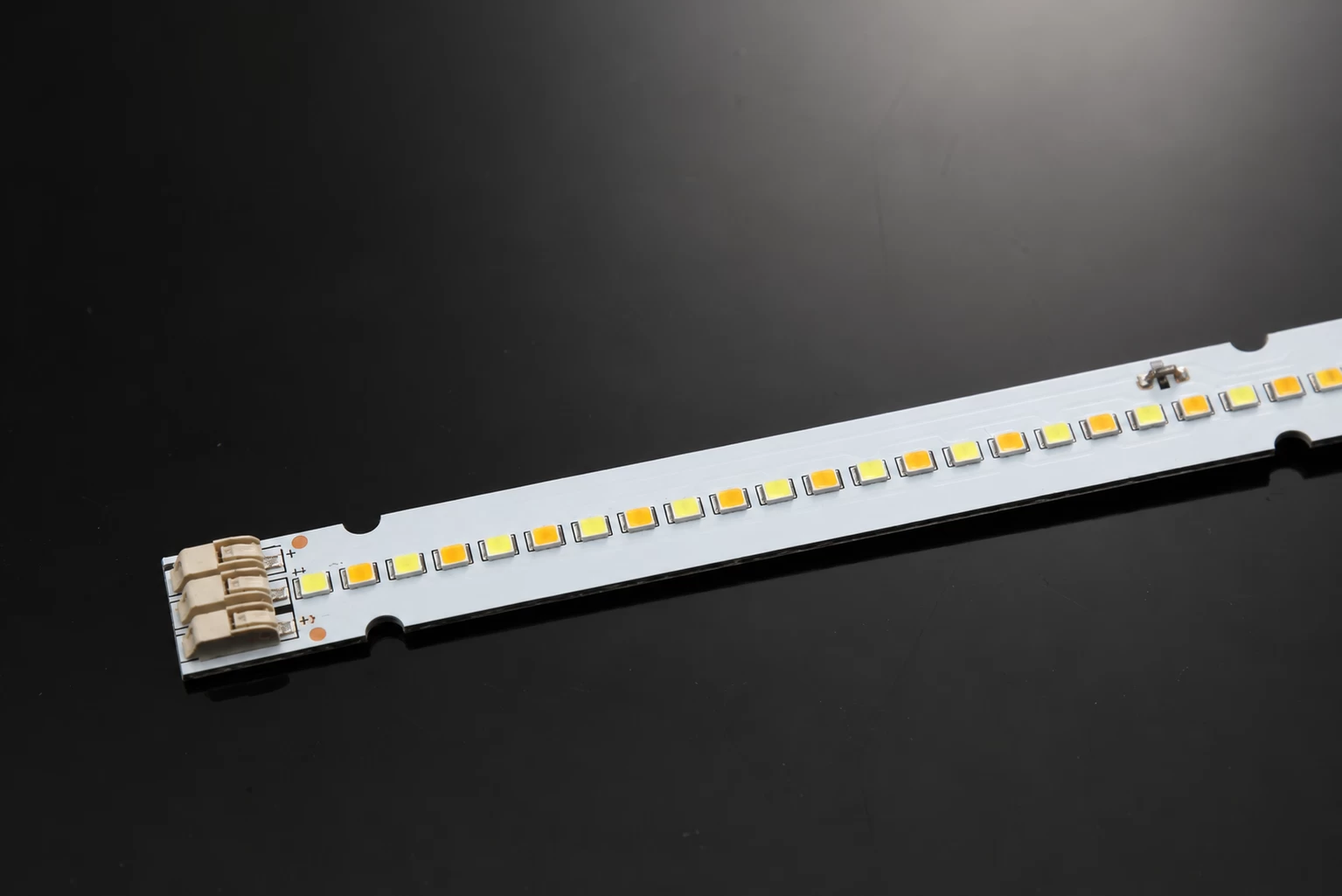
For example, if LEDs from one CCT group are concentrated in one area and the other group is concentrated elsewhere, the final product may require more optical mixing to achieve a visually even result.
The appropriate arrangement depends on the PCB dimensions, LED quantities and the customer's optical structure.
There is also an important distinction between the LED specifications and the final product's output.
Using 2700K and 6500K LEDs does not, by itself, establish the exact color temperature or uniformity of every intermediate setting. Those results depend on the operating conditions and the complete lighting assembly.
NKT develops the LED module. The customer controls the two groups and evaluates the resulting light in the finished product.
Dual-Wavelength UV: Separate Channels With Different Requirements
A 405nm + 450nm UV curing project illustrates a third type of multi-channel design.
The customer needed the two wavelength groups to operate separately rather than illuminate simultaneously.
The selected UV LEDs also had electrical characteristics that needed to be considered when configuring the circuits.
During development, NKT found that the initially proposed LED quantities did not provide a practical series-parallel arrangement under the project's requirements. We reviewed the configuration, recalculated the quantities and asked the customer to clarify the curing energy needed for the application.
The customer's control system determined which UV channel operated. NKT worked on the LED module configuration and PCB design.
This example highlights a difference between multi-channel applications.
In RGBW, channel separation supports color control. In tunable white, it supports adjustment between two white-light groups. In this UV project, it allowed the customer to operate different wavelengths separately.
The underlying requirement is similar, but the LED selection and circuit arrangement cannot simply be copied from one application to another.
The detailed electrical implications of different LED forward voltages deserve separate treatment. Here, the relevant point is that each channel's actual LED requirements must be considered before the PCB configuration is finalized.
The Connector Is Part of the Design, Not Just a Way to Attach Wires
Once the channel requirements are known, the connection interface needs to be considered alongside the PCB layout.
The earlier RGBW project used five terminal positions across three physical terminal components. Other NKT projects have used different connector arrangements, including multipin connectors and separate connections for different channels.
The appropriate arrangement depends on the project.
A connector must provide the necessary electrical connections, but it also occupies PCB space. Its location may affect LED placement, trace routing and accessibility when the customer installs the module.
In some projects, the customer specifies the connector and its location. In others, NKT can propose a suitable position as part of the PCB layout.
This is why connector requirements should be reviewed together with the mechanical drawing, rather than added only after the LED arrangement has been completed.
For a closer look at this issue, see how mounting holes and connectors affect LED PCB layout.
What Must the OEM Customer Provide?
When the customer already has a control system, NKT does not need to design that controller. We do, however, need enough information to develop a compatible LED module.
The most useful starting information includes:
Channel requirements: RGBW, tunable white, UV wavelengths or another channel combination.
Controller electrical outputs: The voltage and current available for each channel, including relevant operating ranges.
Operating requirements: Which channels operate independently, which may operate together and any restrictions that affect the LED circuit.
LED requirements: Required wavelength, CCT, CRI, brightness, luminous flux or UV output, as applicable.
Mechanical information: PCB dimensions, mounting-hole positions, housing restrictions and available installation space.
Connector requirements: Connector type, number of connections and any fixed position or orientation.
Not every customer will have all these details at the beginning.
Some may already have a complete controller specification and mechanical drawing. Others may need recommendations on LED selection or module arrangement.
NKT can review the available requirements, identify missing information that affects the module design and propose a suitable LED configuration for customer confirmation.
This is part of our custom OEM LED module development services.
What Does NKT Validate, and What Remains With the Customer?
Before production, a prototype can be evaluated for the agreed module-level requirements.
Depending on the application, this may include electrical measurements and relevant optical checks, such as white-light output and CCT, color LED wavelength or UV optical power.
The exact measurements depend on the project.
A module-level test does not confirm every aspect of the final product.
For example, a tunable white module still needs to be evaluated with the customer's optics and control settings. A UV module must be assessed against the curing requirements of the actual equipment. The final housing and heatsink also affect operating conditions.
The customer is responsible for validating the completed system, including the controller and application-specific performance.
The distinction between module evaluation and final product testing is discussed further in LED module prototyping before mass production.
A Multi-Channel Module Must Be Designed Around the Product
Multi-channel LED module design is not simply the task of placing several colors or wavelengths on one PCB.
The RGBW, tunable white and dual-wavelength UV projects described here demonstrate different reasons for separating LED channels. They also show why LED selection, electrical configuration, PCB layout and connection arrangements must be considered together.
When the customer supplies the control system, the responsibilities are clear: the customer determines how the channels operate, while the LED module must be designed to work with the specified electrical interface.
For OEM manufacturers developing a new product or replacing an existing LED assembly, providing the controller output specifications and mechanical requirements early can help reduce avoidable changes during module development.
Developing a custom multi-channel LED module?
NKT can review your channel requirements, controller output specifications, LED performance targets and PCB dimensions to evaluate a suitable module configuration.
REQUEST A QUOTE