

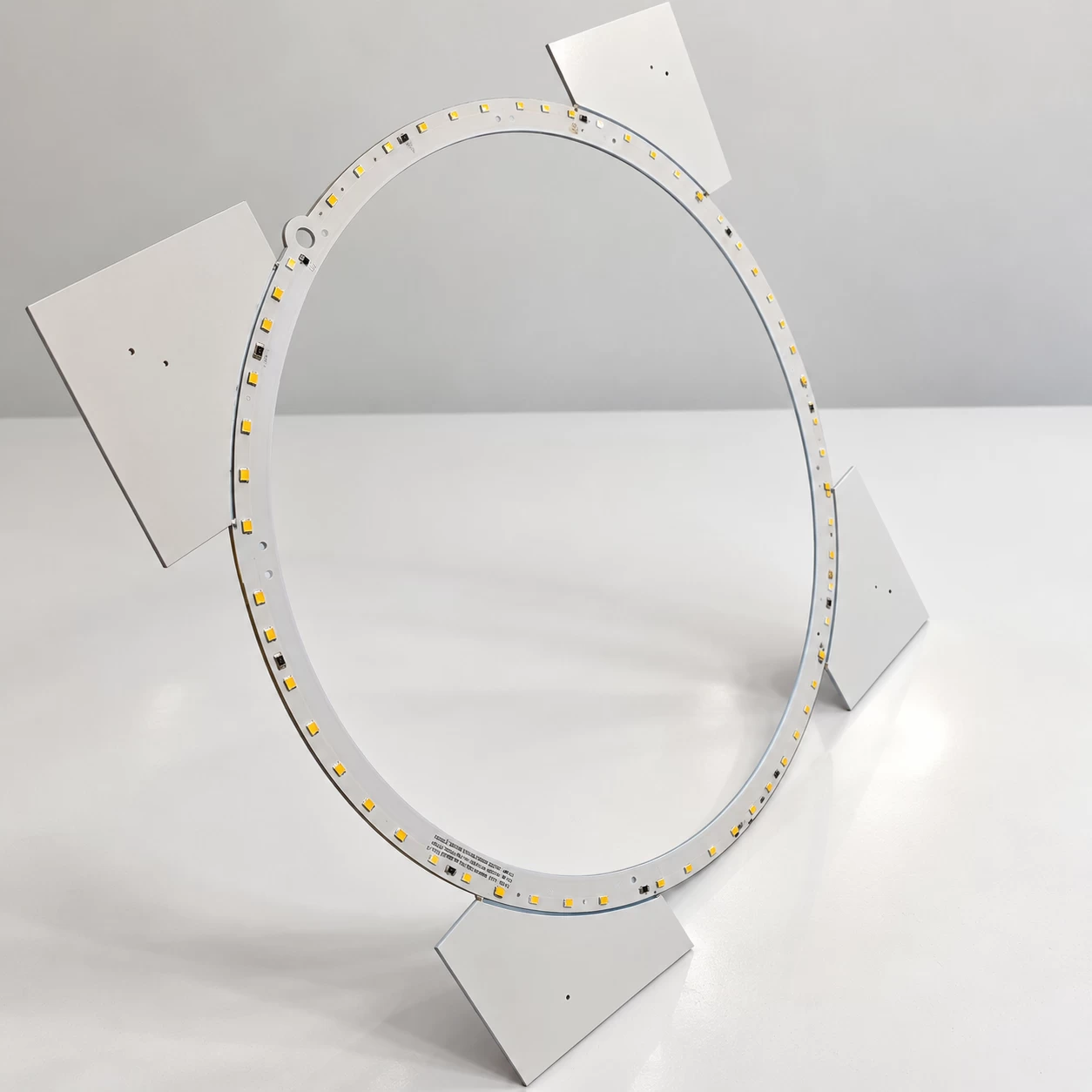
A ring-shaped LED PCB may contain much less material than a solid circular PCB of the same outer diameter.
But that does not necessarily mean its PCB cost will decrease in the same proportion.
We have encountered this in actual NKT LED module projects.
In one 360° ring-shaped LED PCB, a large section of material was removed from the center. However, our PCB supplier explained that the removed center area did not simply disappear from the material calculation. The PCB still had to be produced from an area large enough to accommodate the complete outer geometry.
In another project, a customer required a 180° ring-shaped LED module. A single 180° PCB was technically possible, but its quoted PCB cost was substantially higher than an alternative using four identical 45° curved PCB sections.
The difference was large enough that we changed the PCB structure while keeping the customer's required 180° final module geometry.
For an irregular or ring-shaped PCB, the amount of material visible in the finished board does not always tell you how efficiently that PCB can be produced from the original board material.
Why Doesn't the Center Cutout Reduce PCB Cost Proportionally?
It is easy to look at a ring PCB and think about cost in terms of the material that remains:
Large outside diameter − large center opening = relatively small amount of PCB material.
That describes the finished PCB area, but it does not necessarily describe how much board area is required to manufacture it.
In NKT's sourcing experience, our PCB suppliers have explained that a large ring or curved PCB may need to be calculated based on an area capable of accommodating its complete outer geometry.
The center section may eventually be routed or cut away, but unless that area can be used effectively for another PCB, removing it does not automatically eliminate its material cost.
Our 360° ring LED PCB is a good example.
The finished module contains LEDs around the outer ring while a large area in the center is completely open. Visually, the amount of PCB material remaining is relatively limited compared with the full circular area defined by its outside diameter.
But the large center opening alone does not mean the PCB supplier can charge only for the narrow ring that remains.
Can the Material Inside the Ring Be Used for Another PCB?
Potentially, yes.
If another suitable PCB can be arranged within that center area during production, some of the otherwise unused material could theoretically be utilized.
But in our actual sourcing experience, this is not something we can normally assume.
The dimensions and production requirements would need to suit such an arrangement. Finding another project that happens to make effective use of the center area is possible, but we have rarely encountered that situation in practice.
For an OEM buyer, this means a ring-shaped PCB should not be budgeted simply by estimating the surface area of the finished ring.
The geometry — and how efficiently the supplier can arrange that geometry during production — can matter as well.
A 180° Ring PCB: Technically Possible, but Much More Expensive
We encountered the same issue from a different direction in another LED module prototype.
The customer required a 180° ring-shaped LED module.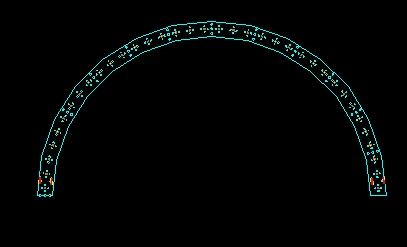
From a technical standpoint, the 180° section could have been produced as one complete PCB. The problem was cost: when we compared the PCB quotations, producing the complete 180° curved board was substantially more expensive.
We therefore evaluated another approach.
Instead of producing one large 180° PCB, the design was divided into four identical 45° curved PCB sections.
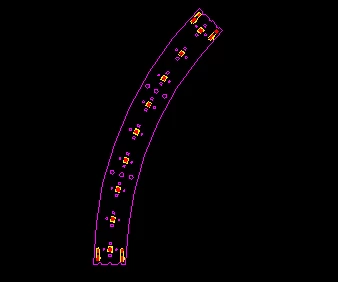
The four sections still formed the required 180° module when assembled, so the customer's required final geometry did not change.
What changed was the way the PCB geometry could be arranged for production.
Smaller identical 45° sections allowed more pieces to be arranged within the available board area. According to our supplier, this improved material utilization and made panel arrangement easier.
The result was a substantially lower PCB quotation than the one-piece 180° version.
We do not have the original percentage difference available, so we would not assign a specific cost-saving figure to this comparison.
This project also remained at the prototype stage. It should therefore be treated as a real sourcing comparison from this particular project, not as a general mass-production cost formula.
The Same PCB Shape Can Create a Different Layout Question
PCB geometry does not affect cost alone.
A ring, round, linear or irregular board also changes the usable area available for LEDs and other components.
That engineering question is covered separately in how PCB shape affects LED layout.
The distinction matters.
In this article, the issue is:
PCB geometry → usable production area → material utilization → supplier quotation.
In the previous article, the issue is:
PCB geometry → usable component area → LED arrangement.
Keeping those two questions separate is important because a PCB concept can work electrically and mechanically while still being inefficient from a sourcing perspective.
The 180° project demonstrates this particularly well.
One complete 180° PCB was technically possible.
Four 45° sections were also technically possible.
But the supplier quotations were very different because the smaller repeated sections could use the available board area more efficiently.
Should a Ring PCB Always Be Divided Into Smaller Sections?
No.
The 180° example does not mean that dividing a ring PCB is always the better design.
A one-piece ring PCB may still be appropriate depending on the product structure, PCB dimensions, electrical configuration, mounting requirements and other project constraints.
Segmenting the PCB also changes the physical architecture of the module, so the individual sections still need to work within the customer's final product.
The useful lesson from the 180° project is therefore not:
“Ring PCBs should be divided into smaller pieces.”
It is:
Before finalizing a large ring or curved PCB, it can be worth comparing how different PCB structures affect material utilization and supplier cost.
This becomes particularly relevant when the PCB has a large outer dimension but much of the enclosed area will ultimately be removed.
Consider PCB Cost Before the Geometry Is Completely Frozen
For a custom LED module, PCB shape normally comes from the application rather than from PCB cost alone.
If the customer's product requires a ring-shaped module, simply replacing it with a conventional rectangular PCB may not be an option.
But there may still be more than one way to create the required geometry.
Before the PCB structure is completely frozen, it can therefore be useful to consider whether the module genuinely requires one continuous PCB or whether repeated sections could meet the same application requirement.
PCB cost should not be the only consideration.
Changing the PCB dimensions or dividing the board may also affect the available area for LEDs. The relationship between LED quantity and available PCB area should therefore be considered together with the electrical and optical requirements.
For projects where standard PCB shapes do not fit the product, NKT's custom OEM LED module development can start from the customer's available dimensions, mounting constraints, voltage range and required light output.
The Finished PCB Area Does Not Always Tell the Whole Cost Story
The 360° and 180° projects illustrate the same sourcing issue in two different ways.
In the 360° board, a large center area was removed, but that did not mean the PCB was priced only according to the narrow ring remaining in the finished part.
In the 180° project, one large curved PCB was technically feasible, but dividing the geometry into four identical 45° sections allowed the supplier to use the available board area more efficiently and resulted in a substantially lower PCB quotation.
Neither example means that every PCB supplier prices every ring-shaped PCB in exactly the same way.
They reflect NKT's actual sourcing experience with these projects and suppliers.
For an OEM project, however, they show why an unusual PCB shape is worth reviewing from both an engineering and a sourcing perspective before the PCB architecture is finalized.
Need a Custom LED Module for a Ring or Curved PCB?
If your product requires a round, ring-shaped, curved or other custom PCB geometry, NKT can review the available dimensions, LED requirements, electrical conditions and module layout before prototype development.
Where PCB geometry creates a significant sourcing or layout constraint, alternative PCB structures can also be evaluated rather than assuming that the first board outline is the only practical approach.