

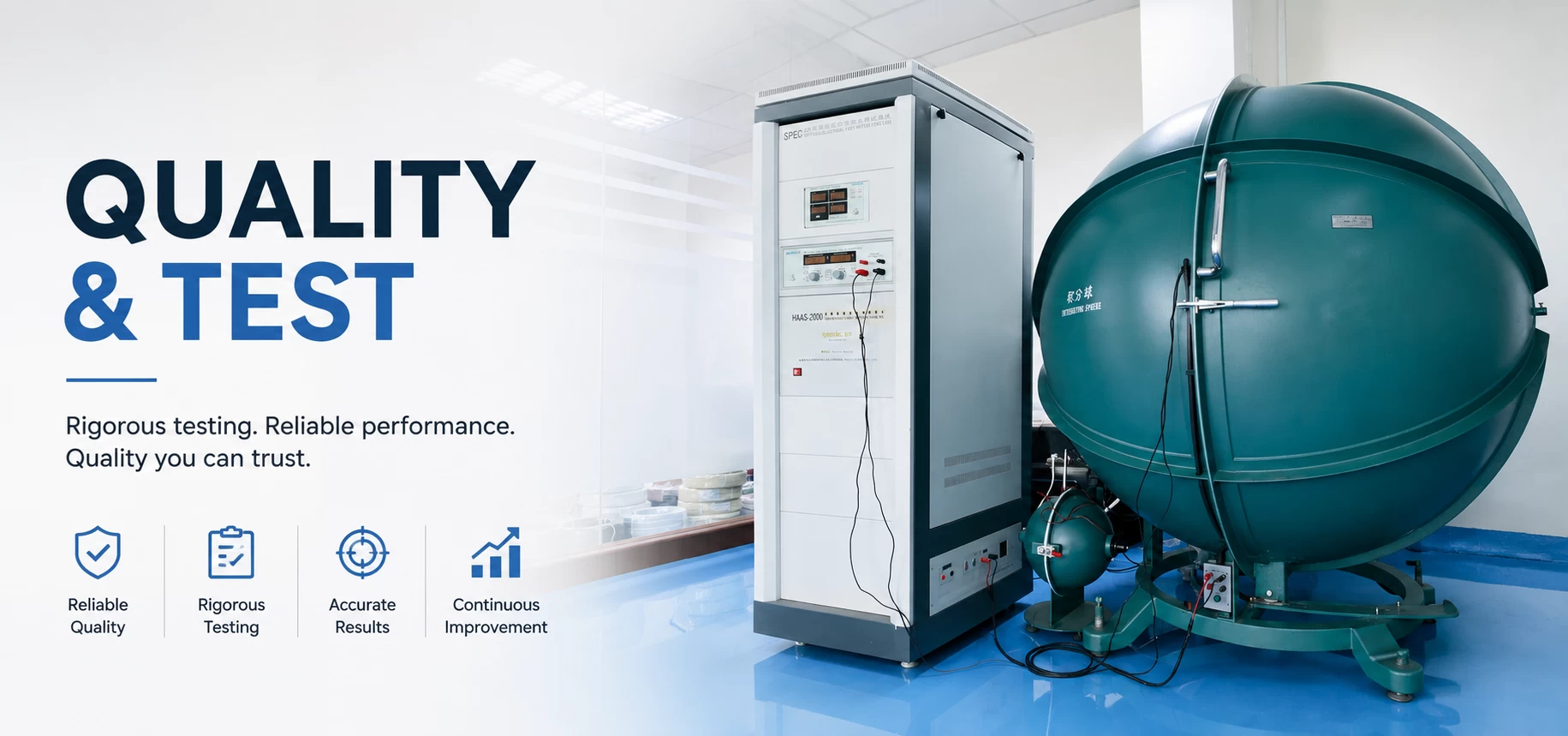
LED Module Quality Control & Testing
For custom OEM LED modules, quality control involves more than confirming that the LEDs turn on.
The approved design, component specifications, assembly quality, electrical and optical performance, and production consistency all need to be considered as a project moves from prototype development into repeat production.
At NKT, quality control focuses on the LED module itself. Our objective is to reproduce the approved design consistently, verify relevant performance parameters, and identify assembly or production issues before shipment.
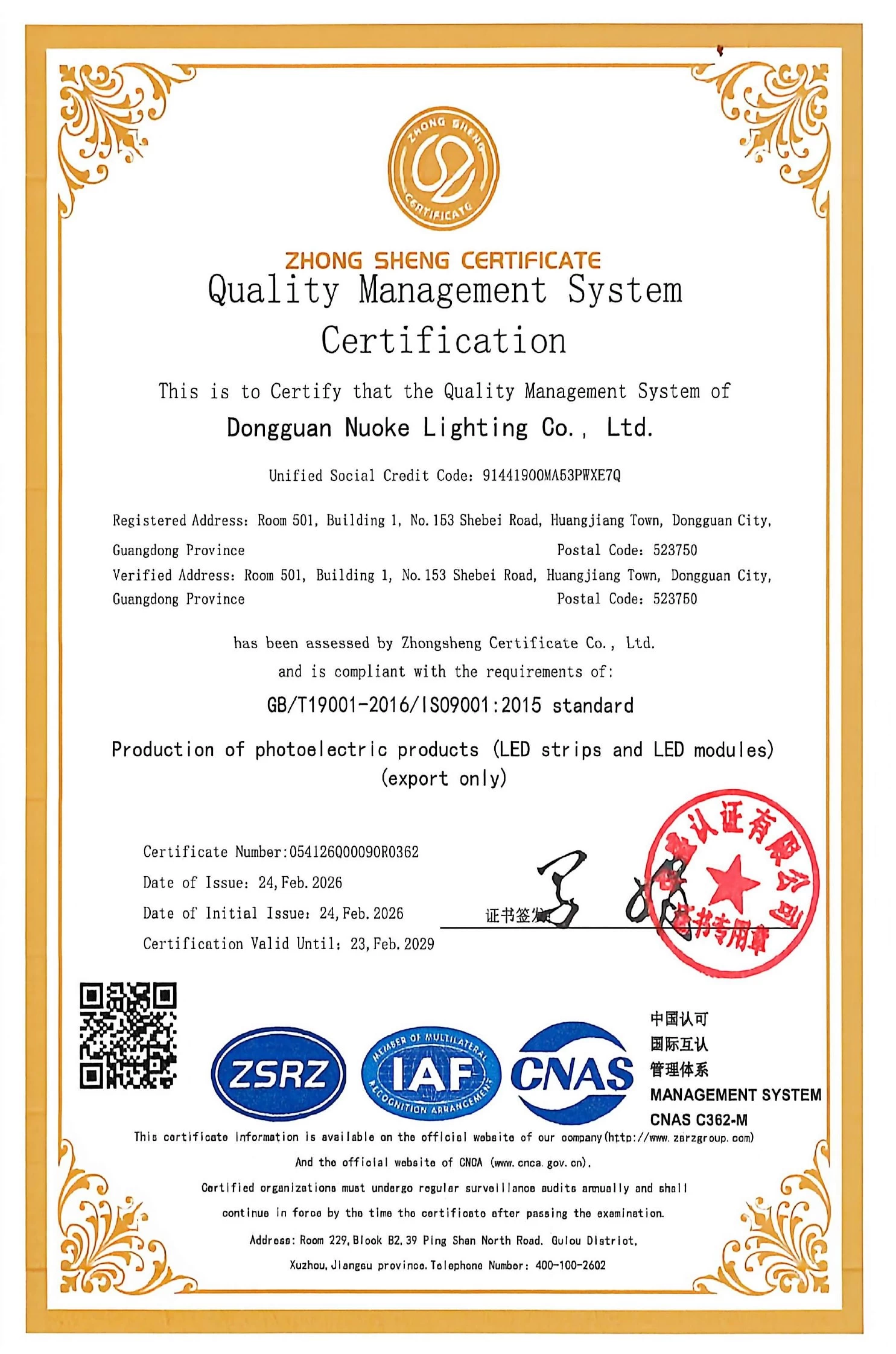
ISO 9001:2015 Certified Quality Management System
NKT works with Dongguan Nuoke Lighting Co., Ltd., our manufacturing entity, whose quality management system is certified to ISO 9001:2015.
The certification covers the production of LED strips and LED modules for export.
This provides a quality management framework for our manufacturing operations, alongside the practical inspection and testing procedures applied to individual OEM projects.
Certification Details
Certified Company: Dongguan Nuoke Lighting Co., Ltd.
Standard: ISO 9001:2015
Certification Scope: Production of LED strips and LED modules (export only)
Certificate No.: 054126Q000090R0362
Quality Control Starts With the Approved Design
For custom OEM LED modules, maintaining the approved design is an important part of production consistency.
Once a design has been confirmed, the approved drawings, BOM, PCB specifications, and component requirements become the reference for manufacturing.
For customer-designed modules, NKT follows the customer's confirmed documentation.
For modules developed by NKT, the approved PCB design and component selection are likewise maintained during production.
We do not substitute customer-specified or approved components without prior confirmation.
This is particularly important for LEDs. Components with the same package size may still have different forward-voltage characteristics, light output, luminous efficacy, CCT, CRI, or other performance parameters.
If an approved component becomes unavailable or reaches end of life, we review the proposed alternative with the customer before introducing it into production. Where necessary, a new sample can be prepared for approval.
For projects involving specific certification requirements, component changes are also reviewed against the customer's applicable requirements.
Assembly Inspection and Electrical Testing
100% Power-On Inspection After SMT Assembly
Every LED module undergoes a power-on check after SMT assembly.
This allows us to identify visible or functional issues, including:
Individual LEDs that do not illuminate
LED strings that fail to operate
Missing or incorrectly assembled components
Connector-related problems
Visible soldering defects
A non-illuminating LED does not necessarily indicate a defective LED component. Depending on the circuit, the cause may involve a solder connection, an open circuit, another component, or the PCB's electrical connections.
When an issue is identified, the module is inspected and the cause investigated before proceeding.
Electrical Performance Checks
Correct illumination alone does not confirm that an LED module is operating within its intended electrical parameters.
NKT checks the assembled module's voltage and current against the requirements established for the project.
For constant-current modules, actual board voltage is influenced by the selected LEDs, their forward-voltage characteristics, and the circuit's series-parallel configuration.
The resulting operating voltage must also be compatible with the intended driver's output-voltage range.
These measurements help identify electrical or assembly issues that may not be apparent during a visual power-on inspection.
Connectors and solder joints are also visually inspected as part of the production quality process.
Optical Testing Based on Module Type
Different LED modules require different optical measurements.
Rather than applying the same test parameters to every product, NKT selects the relevant measurements according to the LED type and project requirements.
White LED Modules
For white-light LED modules, sample and first-board validation typically includes:
Luminous flux (lm)
Luminous efficacy (lm/W)
Correlated color temperature (CCT)
Color rendering index (CRI)
Operating voltage and current
During development, preliminary performance calculations are generally based on LED manufacturer datasheets.
Once a physical sample is assembled, actual measurements help verify the module's performance under the specified test conditions.
If required, the measured results can be used to refine the design before production approval.
During production, optical performance is checked through sampling rather than measuring every individual module in the integrating sphere.
Colored LED Modules
For colored LED modules, relevant optical characteristics include wavelength and brightness.
The selected measurements depend on the LED type and the requirements of the application.
CCT and CRI, which are important for white-light modules, are not normally the relevant performance indicators for single-color LED modules.
UV LED Modules
For UV LED modules, optical power is a more relevant measurement than visible-light luminous flux.
NKT measures UV optical output using equipment appropriate for LED optical power measurement.
The purpose is to evaluate the module's optical performance under defined test conditions.
Optical power measurements at the module level should not be confused with irradiance or curing performance at the working surface of the customer's finished equipment.
Those application-level results depend on the complete system configuration and operating conditions.
Selected 8-Hour Burn-In Testing
In addition to routine power-on inspection, selected production modules undergo an eight-hour continuous operating test.
This provides an additional opportunity to identify abnormal operation or early failures before shipment.
If an issue appears during burn-in, the affected module can be investigated.
The eight-hour burn-in test is a production screening procedure, not an LED lifetime test.
It does not establish the operating lifetime of an LED module in the customer's finished product.
Long-term performance depends on factors including operating current, thermal conditions, installation, and the actual application environment.
Final Inspection Before Shipment
After production and the applicable inspection and testing procedures, LED modules undergo a final power-on check before packing.
This additional check helps confirm correct operation after assembly, inspection, and handling.
The general assembly condition, connectors, and relevant project requirements are also reviewed before shipment.
Depending on the module and project requirements, the production quality process may include:
Approved Design & Components → SMT Assembly → 100% Power-On Inspection → Electrical Checks → Applicable Optical Sampling → Selected 8-Hour Burn-In → Final Inspection → Packing
The exact inspection and testing requirements may vary between projects.
The objective remains consistent: maintain the approved configuration and identify production issues before shipment.
LED Module Testing and Final Product Validation
NKT's testing focuses on the LED module rather than the customer's complete equipment or finished lighting product.
For example, a module may meet its specified electrical and optical parameters during testing, while its actual operating temperature inside the final product will depend on:
The housing and mounting arrangement
Heatsink design and thermal contact
Airflow and ventilation
Ambient temperature
Actual operating current and duty cycle
These conditions can significantly influence the LED module's performance in the finished application.
NKT considers relevant customer requirements during module development, including requirements associated with the customer's intended product certification.
However, final product-level thermal validation, environmental testing, and applicable certification remain the responsibility of the customer.
ISO 9001 certification relates to the manufacturer's quality management system; it does not replace the testing or certification required for the finished product.
Supporting Consistent OEM Production
A successful prototype establishes the starting point for production, but consistency also depends on maintaining the approved design and component configuration.
NKT supports OEM customers through prototype validation, production inspection, relevant electrical and optical testing, and component-change control.
For a new project, prototype validation before production helps establish the reference design.
You can also explore our Engineering Capabilities to understand how we support custom LED module development and production.
If you have an existing LED module design, PCB drawing, BOM, target optical performance, or electrical requirements, please contact NKT to discuss your OEM project